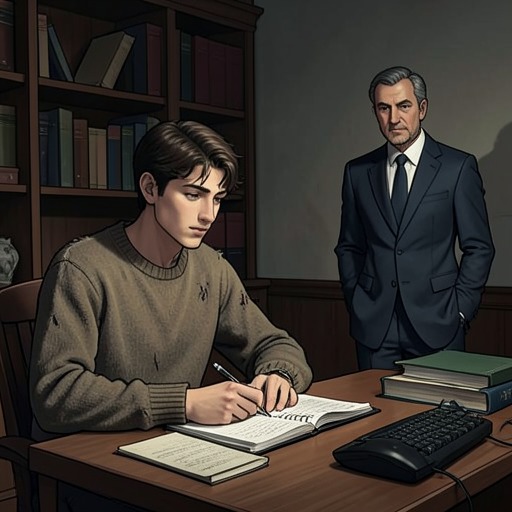
Leo Is Taken Away by Police After Class
Straight ManLeo Is Taken Away by Police After Class is a brief classroom episode in which an ordinary lesson gives way to a police intervention. The campus officers identify Leo as the student they want to speak with; after the professor momentarily insists on his authority over the class, Leo leaves without a dramatic farewell and is led across the lawn in handcuffs to a waiting cruiser. The scene makes his removal unmistakable but does not disclose its cause, preserving a consequential gap in what the reader knows.
Arrival and Identification
As Leo enters the building, a campus security car pulls up. Lou Steinmetz and an officer the professor recognizes from around campus hurry across the lawn. The arrival is visible before it is explained: the movement from car to building places the officers outside the classroom’s ordinary routine, while their quick approach signals that they have come for a particular purpose.
The classroom door then opens, revealing Lou and the uniformed officer. Another campus cop has taken up a position outside the classroom windows. The officers are thus not gathered in a single doorway: one pair enters while another remains beyond the windows. That arrangement gives the encounter a surrounding quality without requiring a confrontation. Lou says he needs to speak to one student and points out Leo. The scene establishes whom the police seek, but offers no accusation, explanation, or account of what prompted their arrival.
The Professor’s Brief Intervention
The professor responds by noting that he is conducting a class. His statement asserts the classroom’s immediate purpose and his authority within it; for a moment, the lesson is treated as a claim on the room that the officers must acknowledge. Lou’s reply is limited: he says he only needs to speak to a student, and identifies Leo. The exchange does not become an argument about the police’s grounds or the professor’s power to prevent them from acting. The professor has marked a boundary, but has not changed the officers’ objective.
After the officers leave the doorway, the professor recognizes the limits of his intervention. Having asserted his position, he has no further use for it, and he cannot find a way back to the story the class had been discussing—Solange’s story. The interruption therefore affects more than the schedule: it breaks the path of the lesson, leaving the professor unable to resume its previous subject. The classroom’s brief contest over who controls the moment ends without resolving why Leo is wanted.
Leo’s Departure
Leo resumes gathering his things and asks whether he may be excused. The professor understands that Leo is focused on the immediate practical meaning of the question: he wants to leave and get on with things. Although the professor thinks he should refuse and keep Leo there as a matter of principle, he does not do so. The class watches as Leo shoulders his backpack and walks to the door.
The departure pointedly resists the conventions of a story. The professor imagines the kind of parting scene in which Leo would stop, turn, and offer a memorable, honest observation—something truer than the writing he has produced during the year. Instead, Leo exits quietly, without a line that could give the moment a neat literary conclusion. The contrast matters: the professor can imagine how to make the scene meaningful as fiction, but recognizes that the event is not fiction and does not supply the satisfying gesture he expects from a character.
Apprehension and Narrative Significance
The quiet exit is followed almost immediately by a visible reversal. The class sees Leo again, now with his hands cuffed behind his back, being led across the lawn toward the waiting cruiser. The officers’ initial request to speak to him has become a physical escort from the building. The evidence confirms that Leo is being taken away by police, but does not establish an offense, explain whether he is under arrest, or say what happens after he reaches the cruiser.
The scene’s force comes from this combination of procedural clarity and missing explanation. Lou identifies Leo, officers position themselves at the classroom, and Leo is led away in handcuffs; the reader can follow the action, but cannot fill in its cause. The professor’s unsuccessful attempt to return to Solange’s story, followed by his recognition that real events do not provide scripted exits, also makes the episode a reflection on the distance between narrative expectation and lived consequence. Leo’s departure is undramatic in manner, yet the handcuffs make its consequence plain. The scene closes on removal, not explanation.